Elk hunting holds a special place in my heart because elk was the first animal I pursued as a hunter. I harvested my first cow elk at the age of 12, eighteen years later I would harvest my first bull elk.
At age 11, when my parents found out the Wyoming Game and Fish Department had changed the legal age to hunt big game from 14, to 12, they asked me if I wanted to hunt. I told them yes, I wanted to hunt elk.
When I was little, my dad, grandpa and a couple family friends would go elk hunting each fall. They would be gone for anywhere from a weekend to a week. When they returned with their harvest, I was always excited to see the elk and help cut up the meat. The idea of being in the mountains pursuing an animal seemed so grandeur to me.
At first my parents were kind of surprised that I wanted to hunt and it caused a little rift in our extended family. I remember a family member being very stern in the fact that women do not hunt and being told women are nurturers, not killers.
My parents took the necessary steps for me to hunt such as registering for hunter safety. And my father taught me how to shoot and safely handle a firearm, to respect the land and wildlife and the ethics of hunting.
I shot my first cow elk at the age of 12 and instead of being traumatized by the experience as some family members predicted I would, I was hooked on hunting.
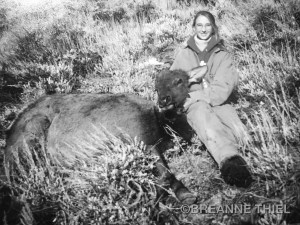
Over the course of the next 18 years, I’ve been very fortunate in the animals I’ve gotten the opportunity to pursue. I’ve hunted deer, antelope, Alaskan moose, bison, bighorn sheep, turkey and accompanied my father on his mountain goat hunt.
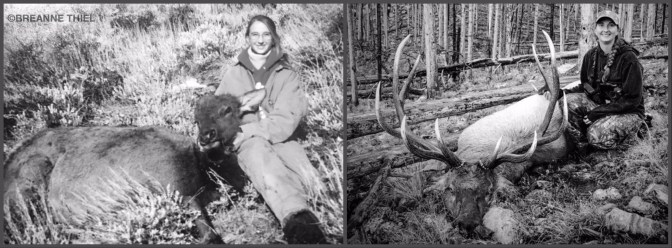
Each hunt, has created memories I cherish. In years to come, when I look back at this bull elk hunt, I’m going to remember independence, accomplishment, friendship and hard work, not the number in which officially entered him into the Boone and Crockett record book.
I will see independence and accomplishment because this is the first time I had a first while hunting without my dad alongside me.
Two weeks before the season opened, my father had shoulder surgery.
While I enjoy hunting with my father and take advantage every chance I get, the fact that I harvested this bull without him, reminded me I can do anything I set my mind to.
This was the third time I had drawn this bull tag. The first time was the same year I drew my sheep tag, and the second time was the year my dad drew his mountain goat tag. So both of those years, I didn’t hunt much for elk. But this year, this bull tag was the only tag I drew.
I set a goal for myself to harvest a mature 6-point bull. This bull surpassed that!
This hunt was done solely on foot. While packing over half my body weight on my back, I got tired both physically and mentally. I had to push myself mentally to keep going. On this hunt I was reminded that your mind will give out before your body will.
Relearning this life lesson will help my mindset while accomplishing whatever goal I set for myself.
I will see friendship and hard work because without the help of friends, this hunt would have been near impossible.
My friend TJ, who does not live in Wyoming, was alongside me throughout this entire hunt. He worked hard not only in hiking in where we did, but also in helping to pack him out.

We had to belly crawl to a good shooting location, where I was able to make a 230 yard shot.
With TJ crawling behind me, he would grab my ankle when a cow, calf or satellite bull looked tentatively in our direction. He would then let go when it was okay to continue on our sneak. To communicate back with him if we needed to stop, I would use hand signals.
On our primarily downhill trek out, he would help me back up when I slipped, tripped or when my legs gave way.
That first day, we were only able to pack out about three-quarters of the meat. Because of this, TJ called his boss to see if it was okay if he was a day late in arriving to his job in Texas.
When my friend Andy found out I had harvested a bull and could use the help, he didn’t hesitate to be there.
Andy switched his days off with a co-worker so he could help us pack out the rest of the meat as well as the head and cape. With his help, the three of us were able to get the rest of my bull out in one trip instead of two.
Neither Andy or TJ had a tag but they were both willing to work hard, and work hard they did to help me. They were just as excited about this bull as I was. I am forever grateful to both TJ and Andy for all of their help.
This year helped in reinforcing my belief in what hunting truly is. For those of us who truly enjoy hunting, it’s the being outside with family and friends and seeing amazing sights that we love. It’s the having to push yourself mentally when you’re tired. It’s not about the kill. This is why, in years to come, this hunt will be remembered and retold as a story of independence, accomplishment, friendship and hard work, not by the official Boone and Crockett net score of 378 ⅛ and gross score of 385 ⅛.
To make the Boone and Crockett all time record book, a bull elk has to have a net score of 375 or higher.

 Breanne Thiel
A great bull and a great reflection on your time spent hunting. That picture of you and your bull is one of the best hunting photos I’ve seen. I think it’s stories like yours, which emphasize why we hunt and not the trophy is what will inspire future boys and girls to want to get into the outdoors for adventures of their own. You have a gift in your writing that leaves me looking forward to your next post. I hope your dad’s shoulder is all recovered for next summer, so he can pull in a red or two!
LikeLike
Thank you Jack! Your words mean a lot to me and I appreciate them sincerely. I really hope that I can make a difference and inspire through my writing. Thanks again for your words!
Dad’s shoulder is healed up now and if you can believe it I think he has more energy now than he did before the surgery, so I have a feeling he will be out fishing us all this summer! 🙂
LikeLike
I love how you push the gender roles in this story! But how it’s also a family story. 🙂
What does it mean when you’ve “drawn a tag”?
The Boone and Crockett scores also don’t mean anything to me as a non-hunter. It may be helpful to translate for people outside hunting culture.
Thanks for sharing your blog!
LikeLike
Thank you Ginger! My goal with my writing is that whoever reads one of my blog posts can take something away from the piece and I enjoy hearing what readers are taking away from my pieces.
To answer your first question, what does it mean when you’ve “drawn a tag” — A tag is another word for license. So to draw a tag means that one applied for a license to hunt a certain animal and their name was randomly selected – or drawn – out of all the applicants for that certain license and so now that hunter can go pursue the animal in which that license is good for.
The state of Wyoming of “broken” into different areas with specific boundary lines – think state lines – and within these boundary lines is an area assigned with a number. That number is the “name” for that area: e.g. Hunt Area 1, Hunt Area 2, Hunt Area 3, etc.
So going back to the state lines, state lines are imaginary lines but one side of the state line is one state and on the other side of the line is another state. What may be legal in one state might not be legal in another state. Each state has their own laws that are enforced within the imaginary state lines. This same concept applies to the hunt areas.
So each hunt area has a distinguished boundary and within that boundary there are regulations such as season dates, how many animals can be harvested, how many of each sex can be harvested, etc.
So when a hunter draws a tag, or license, what and where they can hunt is determined by the license regulations. And the hunter can only hunt in the area in which the license is issued for.
Now this term -draw a tag- is also only really used in limited quota areas. Limited quota areas are hunt areas where only a limited number of tags or licenses will be issued. There is a deadline to apply for these limited quota areas and all of the applicants who apply for those areas are “put into a hat” and applicants names are drawn out. And most of the time in the limited quota areas, there is more hunter applications for those areas than hunting licenses issued and so some areas for certain animals can be very hard to draw a tag and some animals can be very hard to even draw a tag for.
Also with the hunt areas, each species has their own hunt areas or boundary lines. So Hunt Area 1 for elk is not the same as Hunt Area 1 for deer nor is Hunt Area 1 for antelope the same as deer and elk and so on.
I hope this answers your question and if I didn’t explain something clearly please let me know.
To answer your second question in regards to Boone and Crockett – The Boone and Crockett club was founded in 1887 by Theodore Roosevelt.
The Boone and Crockett Club has a scoring system for several big game species in North America. The scoring system is dependent on carefully taken measurements of a horns or antlers in which a numerical score is derived. This score is then used as a “ranking” for how big an animal is. The Boone and Crockett Club has record book where an animal has to have a minimum score in order to be entered into the record book. Harvesting an animal that is large enough to be entered into the Boone and Crockett record book is not something that is commonly done and many hunters will hunt their entire lives and never harvest an animal big enough to be entered.
While the Boone and Crocket Club has this scoring system for measuring animals the mission of the Boone and Crockett Club is to promote the conservation and management of wildlife, especially big game, and its habitat, to preserve and encourage hunting and to maintain the highest ethical standards of fair chase and sportsmanship in North America.
Going into more detail about the Boone and Crockett score was something that I struggled with while writing this piece. I knew that there would be readers of this blog post who would feel similar to you in that the information wouldn’t mean anything but I also didn’t want to go into a lot of detail about it either. I debated about even including the score in the piece.
This hunt to me meant a lot more to me than a number score and looking back on this hunt even now, five months later, as I am writing this response to you I am remembering and seeing those four things I mentioned in the piece – Independence, Hard Work, Friendship and Accomplishment. This hunt reminded me that I can do anything I set my mind to and I think that life lesson was something that I needed to relearn because of where I was in my life at that time. I was at a cross road, not knowing which direction to go, full of self doubt, worry and kind of at a loss with what I was doing with my life. Today, I no longer feel that way. I am full of hope, loving life and when I find myself thinking I can’t do something – I correct my mindset and tell myself yes you can – you can do anything you set your mind to.
Thank you for reading my blog and your comments! I appreciate it and I think you may have given me an idea for my next blog post! 🙂
LikeLike